

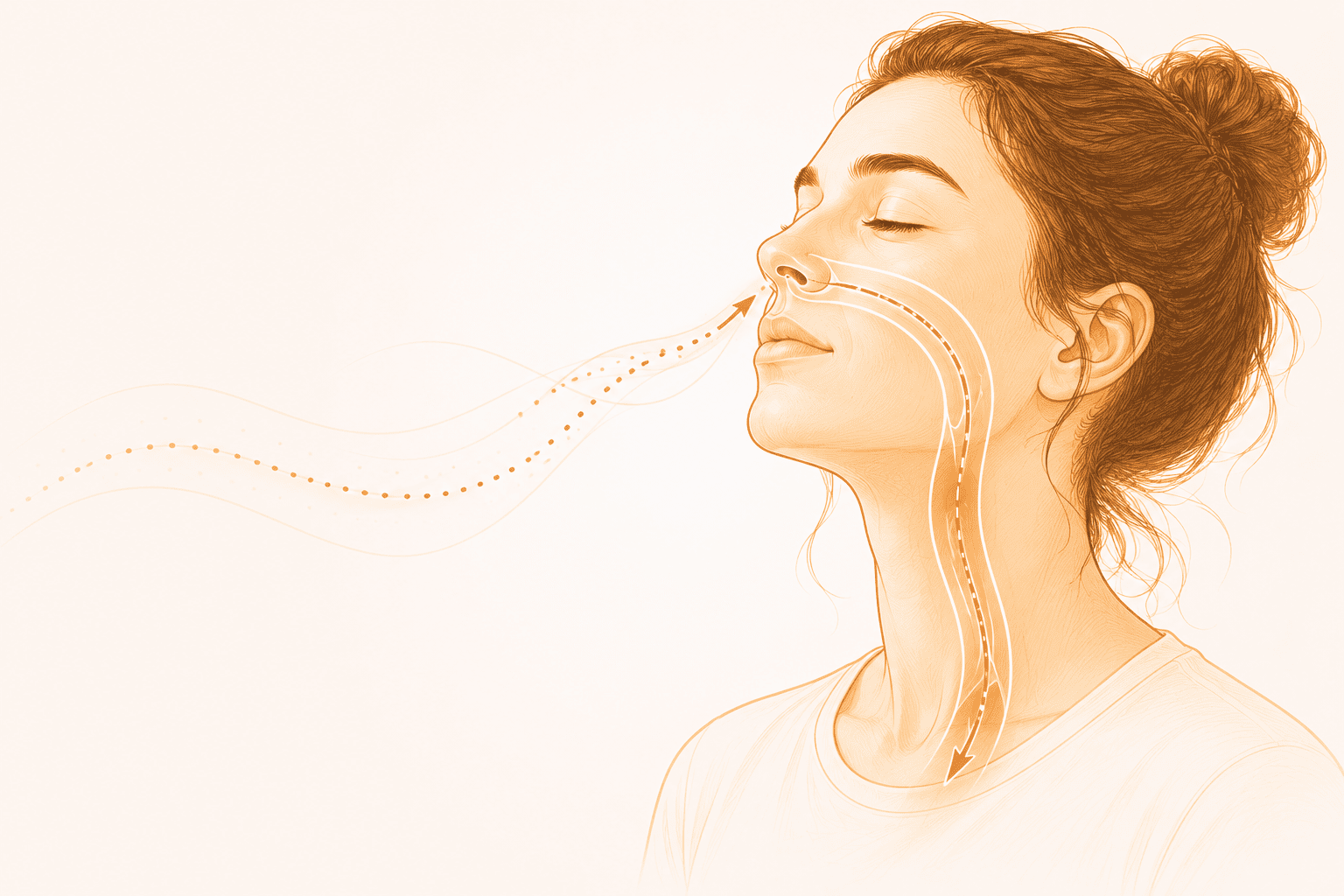
Nasal breathing isn't a technique. It's a default — the one your body should have but doesn't, because for years the tongue has been living somewhere other than the palate. Retraining that default takes eight weeks of structured progression. Skip the progression and you'll try for three days and quit.
Here's the week-by-week protocol that pediatric myofunctional therapists, breath coaches, and elite athletic staff have converged on. Milestones per week. Common plateaus and how to move past them.

Why 8 Weeks And Not 8 Days
Chronic mouth breathers cannot switch to nasal breathing overnight. The nose has been under-used for years and the tissue is often deconditioned. Two things need to happen simultaneously: the nasal passages need to adapt (increased mucus clearance, tissue tone), and the tongue-palate seal that keeps the mouth closed at rest needs to become a neuromuscular default.
Neither happens in a week. Both progress reliably over 4-8 weeks with consistent daily practice. Rushing the intensity produces frustration and quitting; skipping the passive rest-posture work leaves the pattern half-built and it collapses under stress. Mouth breathing: the complete guide →
Week 1 — Awareness & Baseline
Goal: notice how you're breathing throughout the day.
Practice: three times a day — morning, midday, before bed — check where your tongue is and whether your lips are together. Two minutes of quiet nasal breathing at each check.
Milestone: by day 7, you notice mouth-open pattern within a minute of it starting. Awareness precedes correction.
Week 2 — Rest Posture Anchor
Goal: establish the tongue-palate seal as a passive rest position.
Practice: introduce Adult Spot Pal during 30-minute focused-work windows — reading, screen time, deep work. The device provides a tactile "spot" for the tongue to home against without requiring conscious concentration. This is the passive retraining that makes Week 3+ possible. Five breathing exercises →
Milestone: by end of week 2, tongue-palate seal is emerging as a felt sensation you can find on demand.
Week 3 — Nasal-Only At Rest
Goal: establish nasal-only breathing during quiet activities.
Practice: nasal breathing during reading, driving, work-from-desk. If your nose feels blocked at first, this is expected — nasal tissue tone is deconditioned in chronic mouth-breathers. It clears over 5-10 days of consistent use. Continue Adult Spot Pal during focus blocks.
Milestone: by end of week 3, nasal breathing at rest is comfortable and sustainable for hours.
Week 4 — Nasal Warm-Up Under Movement
Goal: extend nasal breathing into light physical output.
Practice: nasal-only during warm-ups, easy walks, and mobility work. If your breath collapses to mouth, back the intensity down until nasal holds. For athletes, this is where Boil & Bite Sport Pal becomes useful — wear during warm-ups to reinforce tongue-palate seal under mild output. Athletic performance pillar →
Milestone: by end of week 4, you can sustain 15-20 minutes of Zone 1 output nasal-only.
Week 5-6 — Sustained Tempo Nasal
Goal: expand CO2 tolerance under sustained tempo output.
Practice: for athletes — nasal-only tempo runs, tempo lifting, bag rounds. For non-athletes — brisk walks, stairs, moderate housework. The transition point from nasal to mouth breathing is what you're pushing higher. Nasal at Zone 2 is where CO2 tolerance measurably expands.
Milestone: the point where you have to switch to mouth breathing moves noticeably higher in intensity. Athletes report better decision-making late in sessions.
Week 7 — Sleep Carryover Check
Goal: confirm the pattern is carrying into sleep.
Practice: ask your partner about snoring pattern. Note morning symptoms — dry mouth, jaw fatigue, morning headache. These should be quieter than baseline. If they're not, the daytime rest-posture window may need more consistency — check whether you're wearing Adult Spot Pal at least an hour a day. Sleep & airway pillar →
Milestone: partner reports quieter breathing at night, morning symptoms improving.
Week 8 — Autonomy Check
Goal: nasal breathing as your default without conscious effort.
Practice: track how often you notice mouth-open pattern. If it's still frequent, extend the protocol another 2-4 weeks. If it's rare — under a few times a day, easily corrected — the retrain has landed. Continue Adult Spot Pal 30-60 min a day as maintenance.
Milestone: mouth-breathing pattern is now the exception, not the default. Progress is autonomous.
Common Plateaus & How To Move Past Them
Nose feels constantly congested.
Expected in the first 2 weeks. If persistent past week 4, evaluate for allergies, deviated septum, or chronic sinusitis. ENT referral is warranted.
Wake up mouth-open despite daytime work.
Rest posture isn't fully autonomous yet. Extend daytime Adult Spot Pal windows to 60+ min. Check sleep position — supine sleepers often need side-sleep support.
Can't get nasal above walking pace.
CO2 tolerance is the limit. This is normal in weeks 3-5 for chronic mouth-breathers. Stay at the intensity where nasal holds and progress will come.
Pattern collapses under stress.
The last thing to lock in. Rest posture holds during quiet work but drops under work stress, conflict, or heavy training. Add a "spot check" cue — a mid-day reset ritual — for 2 more weeks.
Share:
Lifting Under Load: Jaw Clench & Bar Path
TMJ Disorders: A Complete Clinical Guide