

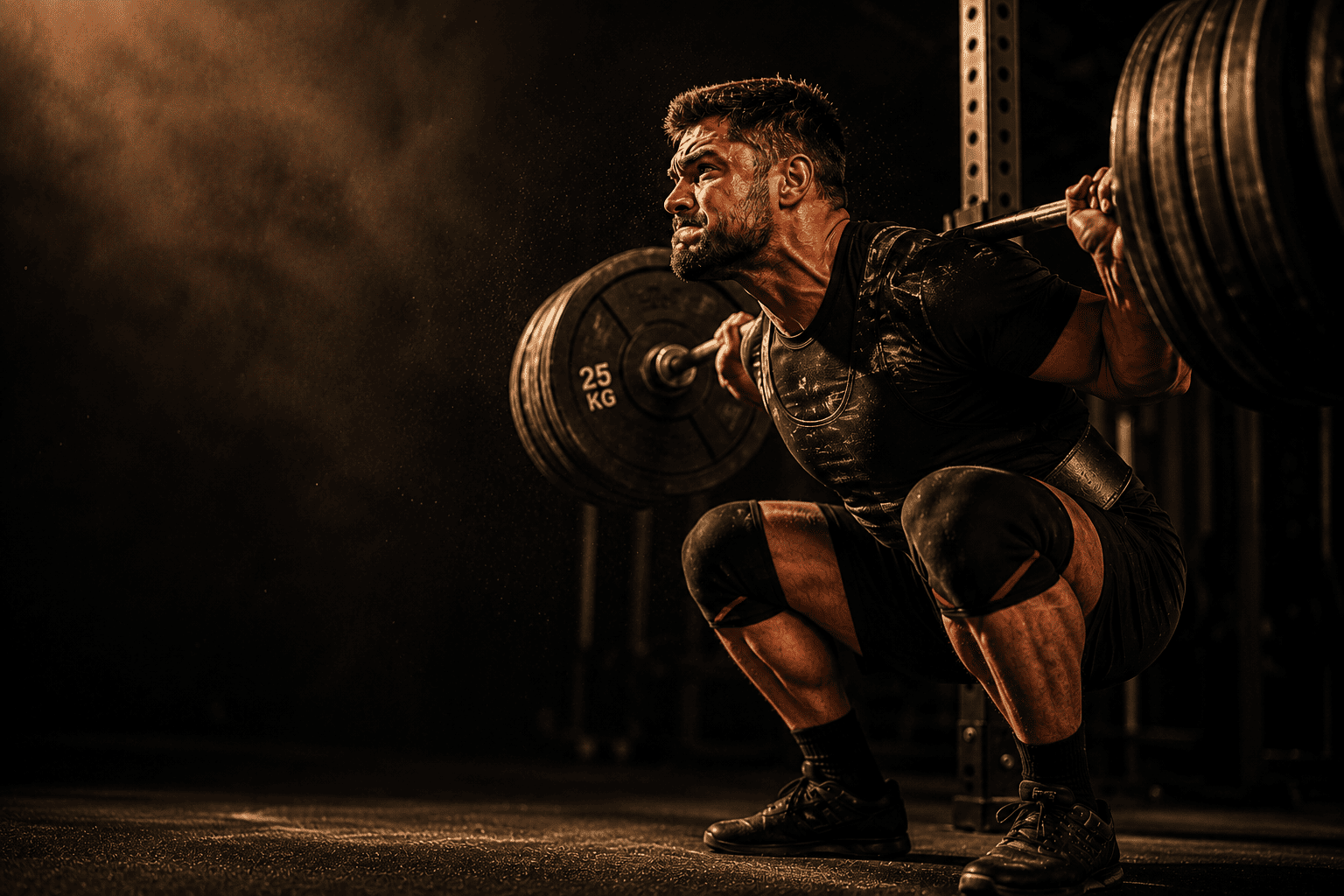
Watch a lifter grind through a heavy single. The jaw clenches, the face contorts, the veins pop. Everyone assumes that's what maximum effort looks like. It isn't. It's what a compromised airway looks like — and it's stealing bar path integrity you don't know you're leaving on the platform.
Elite strength coaches have been quietly building tongue posture into their prep for a decade. Here's why jaw clench under max effort is a compensation, not a technique, and how to retrain it in six to eight weeks.

Jaw Clench Isn't Making Your Squat Go Up
Bracing under a heavy bar recruits the diaphragm, the transverse abdominis, and the pelvic floor. Those muscles produce intra-abdominal pressure — the actual mechanism of a strong brace. The jaw contributes nothing to that pressure. Nothing. It's not part of the bracing chain.
So why does everyone clench? Because the tongue isn't sealing the palate. When the tongue-palate seal breaks, the airway narrows at the top. The nervous system's response — a fast, automatic protective reflex — is to clench the jaw forward to hold the airway open. It's the same mechanism as sleep bruxism, played out during a max lift.
- The clench costs neurological bandwidth. Motor output is limited by CNS drive. Recruiting the jaw for a task it doesn't help siphons drive from the muscles that do.
- It shifts head-neck posture. Jaw clench pulls the mandible forward and the head slightly down. That changes cervical position, which changes force vectors along the spine.
- It creates a leak in the breath. Mouth-open bracing lets pressure escape. Nasal breathing with tongue on palate seals the pressure column — better brace, cleaner rep.
The fix isn't to try harder not to clench. That won't work — the reflex is faster than conscious control. The fix is to retrain the substrate: where the tongue lives at rest. Athletic performance pillar →
Four Signals You're Clenching Instead Of Bracing
Sore temples after a heavy session.
Temporalis fatigue is the local signal. If your masseter is tired the day after squats, you're clenching, not bracing.
Bar drift on heavy singles.
Bar path shifts forward or lateral drift on a max. Often traceable to the head-neck position shift that clench produces.
Mouth-open exhale under the bar.
Air escaping through the mouth mid-rep means the pressure column isn't sealed. Every leak costs stability.
Coach's cue "unclench your jaw."
If your coach keeps having to remind you, that's the reflex firing faster than your intention. The reflex is the target.
The 6-8 Week Retrain Protocol
You don't add training volume. You add a tactile cue to your existing warm-up and light-day work.
Weeks 1-2 — Warm-up cue.
Wear Boil & Bite Sport Pal during dynamic warm-up and mobility. This is where the tongue is finding the palate under low load. No competing intensity to override the pattern. Athlete lander →
Weeks 2-4 — Working sets under 70%.
Wear Sport Pal for accessories and working sets below ~70% 1RM. Nasal-only breathing between reps. Reset the tongue to the palate before each set. The neuromuscular pattern is forming.
Weeks 4-6 — Approach sets on main lifts.
Include Sport Pal on approach sets to your top set — up through ~85%. This is where the pattern starts holding under real load. Bar path noticeably tightens.
Weeks 6-8 — Competition carryover.
By this point rest posture is autonomous. Remove Sport Pal for top singles and competition — the tongue-palate seal holds without the appliance. Continue wearing Sport Pal in warm-ups and volume work to reinforce. TMJ pillar for jaw clench mechanism →
"Been squatting seventeen years. Coach kept telling me my head cue was off on my top sets — bar would drift forward. Assumed I needed more upper back work. Six weeks with Sport Pal in warm-ups, focusing on tongue on the palate. My top set video looks different. Bar path is cleaner. Same weight, cleaner rep."
Common Questions
Should I wear Sport Pal for a competition attempt?
Depends on federation rules and personal preference. Sport Pal is a training tool that reinforces the tongue-palate pattern; once the pattern is autonomous (usually 6-8 weeks in), most lifters don't need it during top singles. If you find the tactile "spot" still helps focus at heavy loads, wear it in warm-ups and take it out for the actual attempt.
Is this the same as Valsalva?
No. Valsalva is the breath-hold bracing maneuver — filling lungs, closing glottis, creating intra-abdominal pressure. Tongue-palate seal is where the tongue lives during that Valsalva. Doing Valsalva with tongue against palate seals the pressure column better; doing Valsalva with tongue dropped leaks pressure through the mouth and recruits jaw clench.
Will this make my working weights go up?
We don't make PR claims. What lifters consistently report is cleaner bar path, better position under fatigue, less morning jaw soreness after heavy sessions, and quicker between-set recovery. Whether that shows up on the platform depends on the lifter and the program. If your position under load has been the limiting factor, the effect can be meaningful.
Does this help for bench and deadlift too?
Yes for both. Bench: reduces neck-flexion recruitment and cleans up leg drive coordination. Deadlift: tongue-palate seal at the top of a deadlift is where a lot of lifters lose their brace at lockout. The mechanism applies across compound lifts.
Sport Pal or a competition mouthguard?
Different tools. Competition mouthguards are impact protection (relevant if your sport requires ASTM certification). Sport Pal is a tongue-posture training tool. If you compete in strongman, powerlifting, or Olympic lifting, impact certification usually isn't required — Sport Pal is fine. If you compete in combat sport, use both: Sport Pal in warm-ups and drilling, your comp guard for hard sparring and events.
Share:
Tongue Thrust in Kids: What Parents Should Do
How to Retrain Nasal Breathing: An 8-Week Progression