

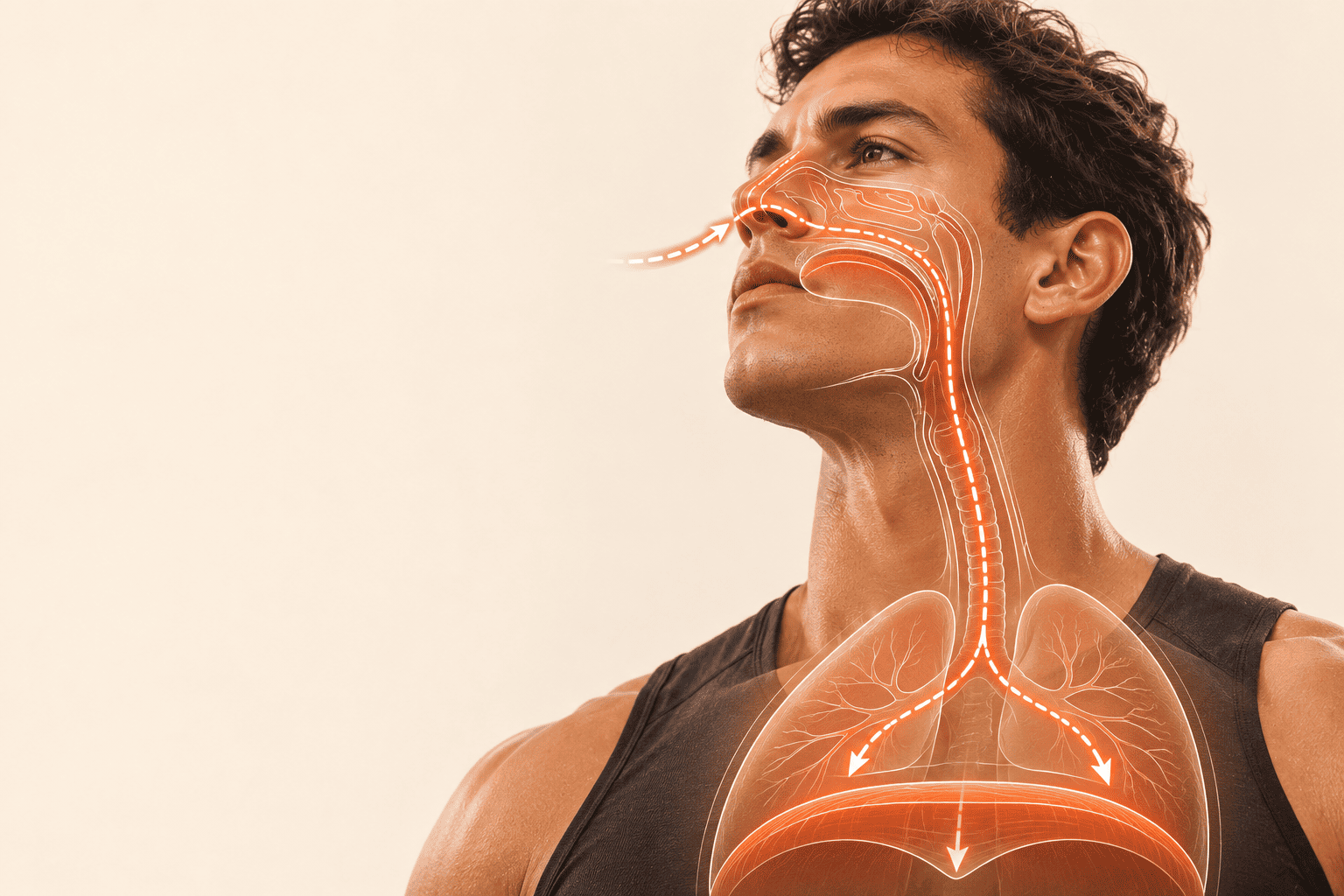
Your late-round conditioning, your bar-path stability, your recovery sleep — they all trace back to something most athletes never train.
Tongue posture and breathing mechanics run the systems your program takes for granted. Here's the complete guide — what athletes miss, why it matters, and how to train it in two to five minutes a day.

What Athletes Miss About Their Own Breathing
Most training programs treat breath as a byproduct — something that happens because you're moving. Elite endurance coaches, combat trainers, and increasingly performance PTs treat it the other way: breath is a system you train, and the way you train it is by fixing where your tongue lives.
Here's the mechanics athletes typically don't know:
- Nasal breathing produces nitric oxide. The paranasal sinuses release NO with every nasal breath, which dilates the airways and increases oxygen uptake by an estimated 10-15% compared to mouth breathing. Skip nasal, skip the NO.
- Mouth breathing under load flushes CO2 too fast. That destabilizes the Bohr effect — the mechanism that releases oxygen from hemoglobin into working muscle. Low CO2 tolerance is why some athletes "gas out" long before their cardiovascular capacity is actually the limit.
- Tongue posture stabilizes the airway from the top down. When the tongue seals against the palate, the base of the tongue pulls forward — keeping the airway open at high load. When it drops, the airway narrows and every breath costs more work.
- Jaw clench recruits force that isn't producing output. Clenching under max effort is a compensation for a tongue that isn't stabilizing the palate. That clench costs neurological bandwidth and produces zero bar-path improvement.
These aren't fringe biohacking claims. Nasal breathing under exertion has been formally studied in endurance sport (Dallam, MacIntosh et al., Int J Kinesiol Sports Sci) and adopted by coaches at increasingly higher levels of combat and endurance training. The mechanism is the tongue.
Signs Your Breathing Mechanics Are Underperforming
If your program is dialed in and you're still hitting the same conditioning ceiling every session, one of these is probably true.
You gas out at rep eight.
Not because your legs are done — because your breath collapsed through the mouth and CO2 stacked. Same session, three sets in.
Your jaw locks between sets.
Feel it in your temples on the walk to the car. That clench under max effort is compensation, not output.
You snore or breathe mouth-open at night.
Recovery lives in parasympathetic sleep. Mouth breathing all night means shallow sleep. Muscle growth and central-nervous-system rebuild both drop.
You wake up already fatigued.
Eight hours in bed, morning heart rate elevated, no CNS bounce. That's not overreach. That's under-recovered from the sleep itself.
The Five Systems Tongue Posture Runs In Sport
Every athletic system that matters — output, control, recovery, mental focus — traces upstream to tongue posture and breath mechanics. When those are trained, five downstream systems tighten. When they're not, everything else compensates.
1. Nasal breathing + CO2 tolerance
Nasal breathing produces nitric oxide, humidifies air, and paces respiration slower and deeper. Under load, athletes who stay nasal for longer have higher CO2 tolerance (more oxygen delivered to working muscle) and cleaner heart-rate responses. The transition point where nasal collapses to mouth is where most conditioning ceilings live. Mouth breathing: the complete guide →
2. Jaw stability under maximum effort
Clenching through a lift, a strike, or a sprint is a compensation — the jaw is holding load that the tongue-palate seal should hold. That clench doesn't produce more output; it steals neurological bandwidth from what does. When tongue posture stabilizes the upper airway, the jaw is free to do only its job, and bar path/form cleans up. Tongue posture: the complete guide →
3. Postural chain and force transfer
The tongue is the top of a fascial chain that runs down through the hyoid, throat, chest, and pelvis. When it drops, the head goes forward, the ribs compress, and the front line shortens. Force transfer through that compromised chain is what shows up as "grinding" reps that used to be clean. From lips to hips — the postural chain →
4. Sleep architecture and CNS recovery
Mouth breathing during sleep fragments the parasympathetic dip that grows the muscle you just tore. Snoring, dry mouth, and morning fatigue are the signals. The tongue posture that keeps the airway sealed at night is the same one that keeps you nasal on the treadmill. Training it during the day tightens the sleep pattern at night. On sleep and workout performance →
5. Focus and interoception under stress
Nasal breathing is slower, deeper, more parasympathetic. It also gives you a proprioceptive anchor — a way to notice the internal state that's easier to feel than heart rate. Coaches who train breath-first see athletes make cleaner in-competition decisions because the nervous system isn't running hot. Five ways to boost focus during a game →
How To Train Tongue Posture Into Your Program
You don't add a new training block. You add a two-to-five minute daily practice that stacks on top of what you already do. Progression matters — nasal-first at rest, then at low intensity, then under load, then under competition stress.
Step 1 — Baseline: nasal breathing at rest.
Two to five minutes a day at rest. Mouth closed, tongue against the palate, breath slow through the nose. This is the neuromuscular baseline. If your nose feels blocked at first, that's expected — nasal tissue adapts to consistent use over two to four weeks.
Step 2 — Warm-up nasal window.
Warm up nasal-only. Zone 1-2 output only. If your breath collapses to mouth, back the intensity down until it holds. This teaches your CO2 tolerance to expand and gives your tongue-palate seal repetitions under low stress.
Step 3 — Sustained tempo nasal-only.
Once you can hold nasal breathing in zone 2, add nasal-only tempo work — steady-state runs, tempo sets, easy bag rounds. This is where CO2 tolerance actually expands. See five breathing exercises with a Spot Pal for the drill progression.
Step 4 — A physical target: Boil & Bite Sport Pal.
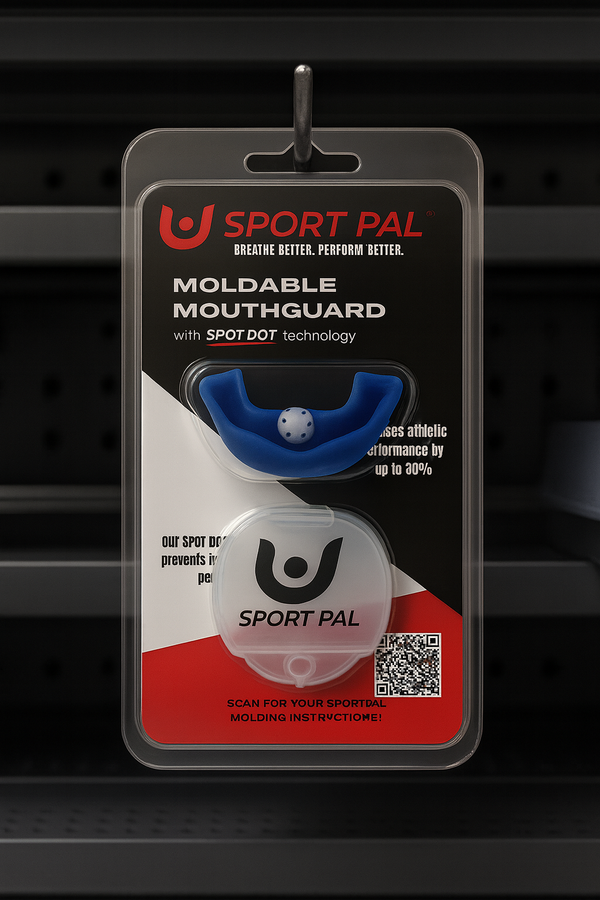
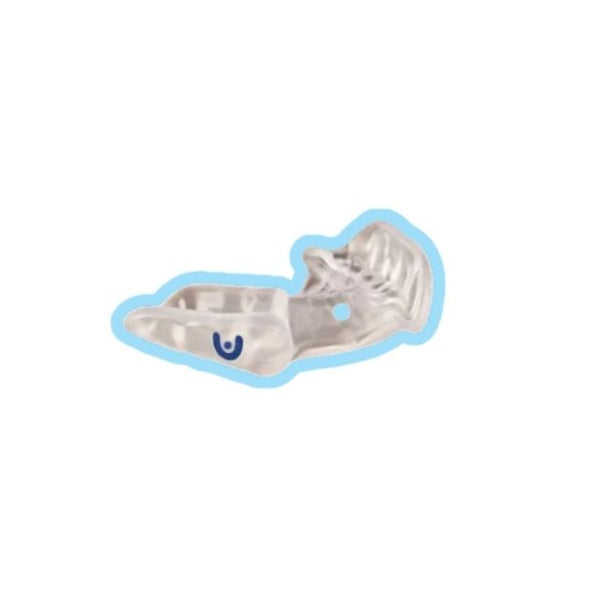
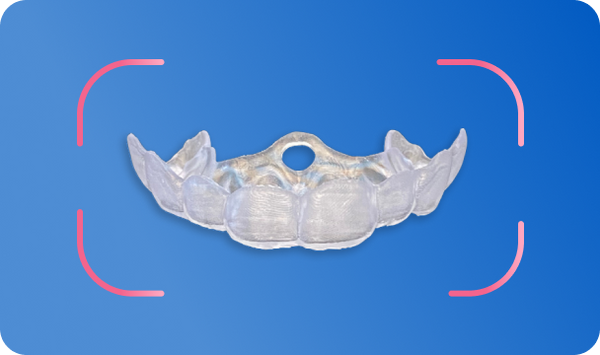
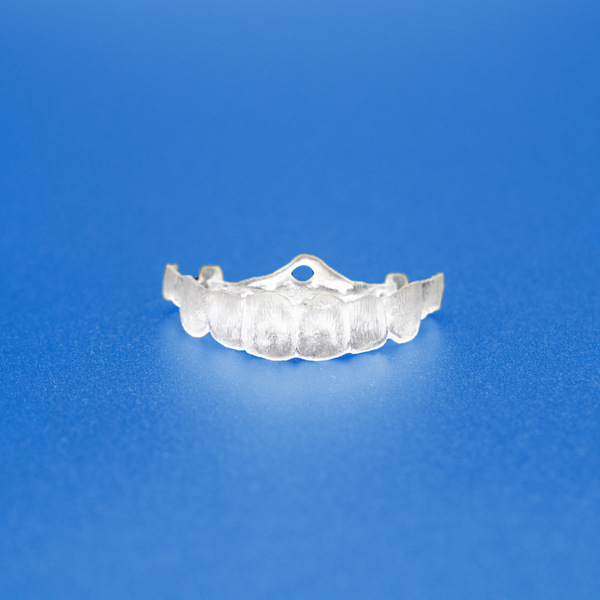
This is where Boil & Bite Sport Pal works. It's a patented moldable mouthguard with a Spot Dot tactile cue — a physical landmark for the tongue to lock against during training. Custom-fits in 60 seconds. Re-moldable up to 10 times. Wear it during warm-ups, mobility, and light-to-moderate training to reinforce the tongue-palate seal rep by rep.
Ready to train it? Boil & Bite Sport Pal fits in 60 seconds and ships with re-mold capacity if the first bite isn't right. 30-Night Trial.
Shop Boil & Bite · $34.99Sport-Specific Applications
The mechanism is the same across sport, but where you first feel the benefit differs. Here's how the training shows up by discipline.
Lifting (powerlifting, Olympic, general strength)
Clenching drops. Bar path stays cleaner because the jaw isn't recruiting force that doesn't move the bar. Recovery between heavy sets tightens.
Combat sport (BJJ, boxing, MMA, wrestling)
Late-round conditioning is where you win. The athletes who stay nasal longer under fatigue keep decision-making sharp and gas last. This is where most coaches see fastest lift.
Endurance (running, cycling, triathlon)
CO2 tolerance and lactate-clearance both benefit. The moment nasal breathing collapses to mouth is the tempo ceiling; training tongue posture pushes that ceiling higher.
Recovery + off-season
This is where the systemic benefits compound. Better sleep, less inflammation, more parasympathetic recovery = more supercompensation from the same training load.
"My half-marathon time was stuck for three years — I thought it was training volume. Coach kept saying 'work on your breath,' I thought he meant intervals. Six weeks of nasal-only tempo work with Boil & Bite Sport Pal and I dropped time. Not from getting faster. From stopping the mouth-breath collapse at mile eight."
Build Your Stack
Common Questions
What's the actual science on nasal breathing under load?
Nasal breathing produces nitric oxide (a vasodilator), humidifies and filters air, and paces respiration slower and deeper than mouth breathing. Under exertion, athletes who sustain nasal breathing for longer maintain better CO2 tolerance and cleaner oxygen delivery to muscle. Formal studies (Dallam et al., MacIntosh et al.) have documented respiratory-efficiency gains in endurance athletes trained nasal-only over 4-6 weeks.
When should I switch to mouth breathing?
At true maximum effort — everyone mouth-breathes eventually, and that's built in. The training goal isn't to be nasal-only forever. It's to push the point where nasal collapses to mouth as high as possible. That's where conditioning ceilings sit for most athletes.
How does tongue posture help my recovery, not just my performance?
Recovery lives in parasympathetic sleep. Mouth breathing during sleep fragments the deep-sleep architecture where CNS rebuild and muscle-protein synthesis happen. Training tongue posture during the day carries into nighttime — the tongue that seals the palate awake is the tongue that keeps the airway open asleep. Better sleep, more supercompensation from the same load.
Which sport benefits most from this?
Combat and endurance athletes see the fastest lift because their sport lives in the CO2-tolerance zone — the space where nasal breathing under load is the difference between clean output and a fade. Lifters see it in cleaner bar-path and less jaw clench. Recovery gains compound in every sport equally.
Does Spot Pal replace mouthguards, night guards, or breathing exercises?
No. Boil & Bite Sport Pal is a training tool, not an impact-rated mouthguard — if your sport requires ASTM certification for impact, treat Sport Pal as supplemental. Night Pal is a separate SKU for grinding + nighttime tongue posture. Breathing exercises like box-breathing complement Sport Pal — the device gives your tongue a target while you drill.
How long to see a change?
Most athletes notice the tongue-palate seal awareness within one to two weeks of daily use. Nasal-tolerance changes under load typically emerge in weeks four to six. Full habit shift — where the pattern holds through competition and sleep — takes eight to twelve weeks. 30-Night Trial gives you a full month to feel the first phase.
Share:
Mouth Breathing: The Complete Guide
Speech Development: The Complete Guide