

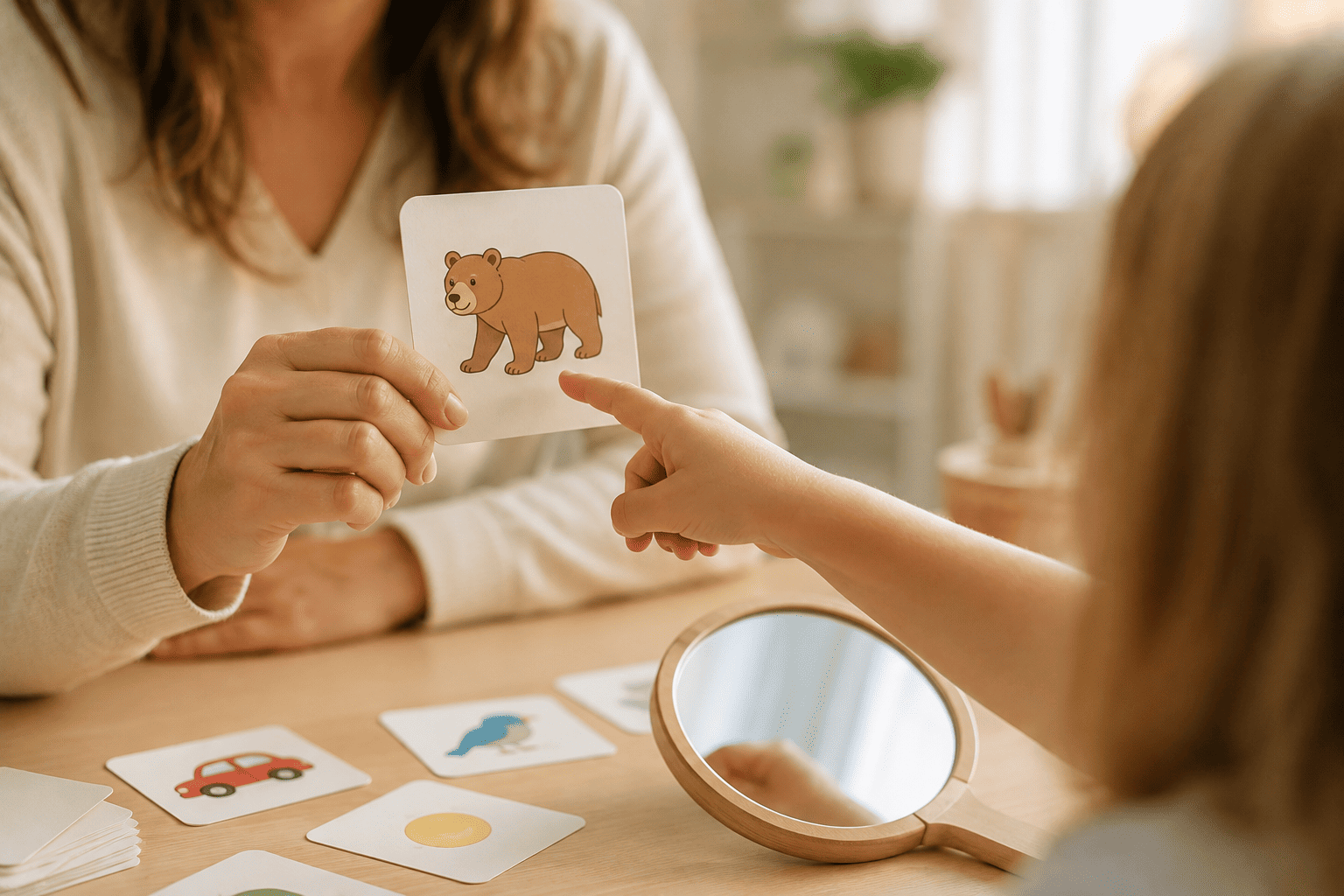
If your child is 7 or older and /r/ still hasn't fully acquired, you're not late — you're at the exact age most SLPs start focused /r/ work. What matters now is picking a protocol that addresses substrate, not just sound production.
Here's why the /r/ is uniquely difficult, what modern SLPs actually do, and how a patented resting-posture appliance shortens the timeline meaningfully.

Why /r/ Is The Sound That Takes Longest
Most English phonemes have a single defined tongue position. /r/ doesn't. It has two valid production styles (retroflex and bunched) and produces 32 distinct allophones depending on the surrounding sound context. In simple terms — /r/ in "run" is different from /r/ in "bear" is different from /r/ in "car."
Because of that complexity, /r/ is developmentally the last major English consonant to acquire — most kids master it fully between ages 6 and 8. If your child isn't there by age 7-8, focused therapy is warranted. If they're not there by age 9-10, therapy tends to become more structured because the pattern of substituting (w/r or l/r) has hardened. Practical exercises for articulation →
The variable most standard therapy misses: where the tongue lives at rest. If your child's tongue defaults to the floor of the mouth (low resting posture), every /r/ attempt starts from too far away. Fatigue, speed, and stress reveal the underlying posture. Adding substrate work to articulation drills consistently shortens the /r/ acquisition timeline. Speech pillar →
The Modern /r/ Therapy Protocol
Phase 1 — Myofunctional evaluation.
Not every SLP incorporates myofunctional assessment, but the ones who do get better /r/ generalization results. Ask specifically: "Do you evaluate for tongue posture and tongue tie before starting /r/ work?"
Phase 2 — Substrate work (weeks 1-6).
Rest posture retraining with Spot Pal Junior. 30-45 minutes during homework or quiet reading. Establishes the tongue-palate seal that makes /r/ production start from a reachable position. Substrate before sound. Tongue posture pillar →
Phase 3 — Isolated /r/ elicitation (weeks 3-8, overlaps).
SLP identifies which /r/ style — retroflex or bunched — produces the cleanest sound for your child. Practice sustained /r/ hold, growl-and-hold, and mirror-check work. Building the isolated production the child can find on cue.
Phase 4 — Word-level (weeks 6-12).
Simple words: "run," "red," "rain." Then vocalic /r/ words: "bear," "here," "star." Then multi-syllable: "February," "library." Consistent daily practice.
Phase 5 — Conversation carryover (weeks 10+).
Structured reading aloud, then unstructured conversation. Watch for drift in fast speech or under fatigue. Continued Spot Pal Junior use for substrate reinforcement. Signs child has tongue thrust →
"Our son was 8 and stuck on /r/ despite two years of standard speech therapy. Every session showed clean production, but conversation was still w-for-r substitution. New SLP added myofunctional evaluation — low tongue posture. Added Spot Pal Junior during homework hours. Twelve weeks later /r/ generalized in conversation for the first time. Same drills as before. Different substrate."
The Kids /r/ Family


Common Questions
What age should we start /r/ therapy?
Most SLPs formally treat /r/ starting age 7. Kids under 7 who are close to acquiring often complete it on their own — watchful waiting with occasional check-ins is reasonable. If not acquired by 7-8, referral is warranted.
How long does /r/ therapy take?
Individual variation is significant. Typical range: 3-12 months of active therapy plus consolidation. Kids with substrate work (myofunctional + resting-posture appliance) added tend to move faster because the underlying tongue posture is being fixed in parallel.
Does insurance cover pediatric /r/ therapy?
Usually yes with a diagnosed articulation disorder. School-based SLP services often available for eligible kids. Private practice fees vary by region. Coverage for myofunctional-adjacent work varies significantly by plan.
Should I do at-home /r/ exercises?
Coordinate with your SLP. Home practice significantly boosts /r/ therapy outcomes — but incorrect production during home practice can reinforce wrong patterns. Ask your SLP for a short list of specific drills to work on between sessions, along with what "clean production" should sound like.
Will my kid outgrow /r/ without therapy?
Some do. Most who haven't acquired by age 8 don't outgrow it and carry the pattern into adulthood. Therapy in the 7-10 window is the standard-of-care recommendation for most kids not acquiring on their own.
Share:
Botox vs Myofunctional Therapy For TMJ: When Each Actually Fits
Recovery & Sleep For Athletes: The Airway Variable Nobody's Programming